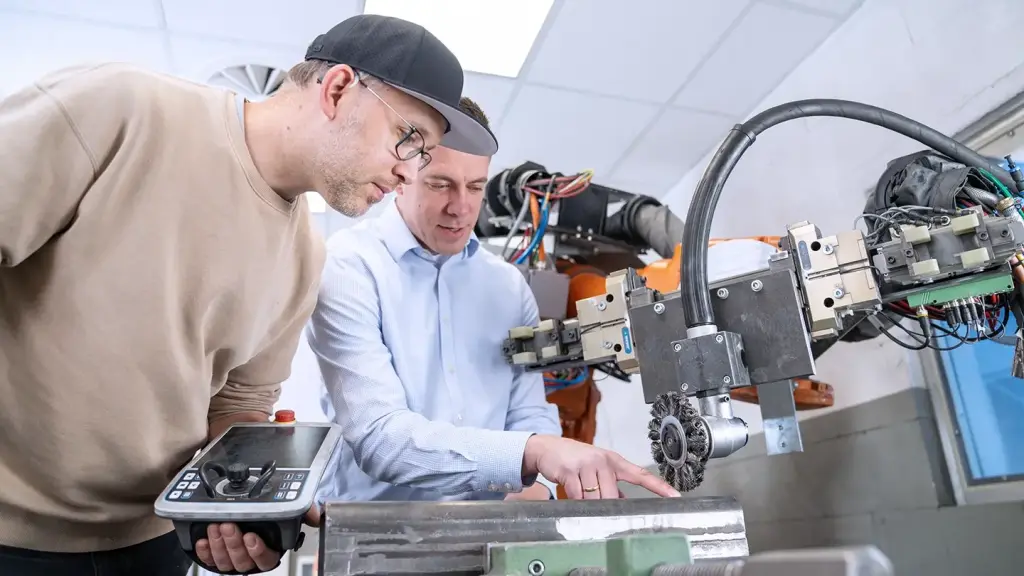
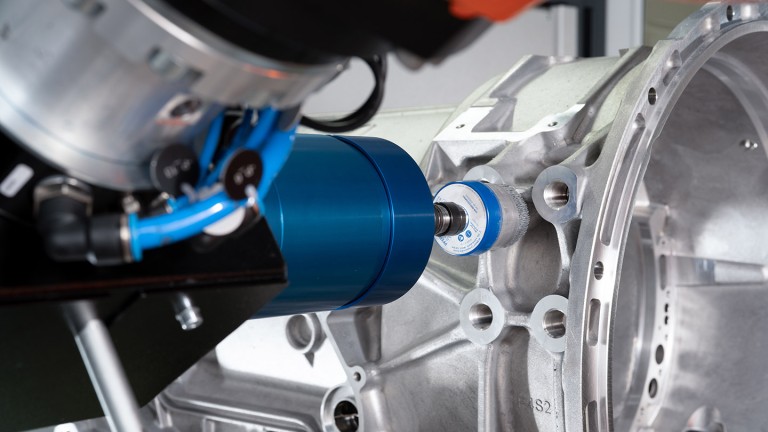
Automation improves quality, efficiency and competitive advantage. But just a robot on its own doesn’t guarantee the machining process will be reliable. What matters is that the interplay between the tool, drive system, process parameters and application is coordinated. “If you automate an unreliable process, you’ll still have its fluctuations to contend with,” says PFERD TOOLS CSO Jörg Hesse.
More and more companies are automating their production process. This pressure to take action is being driven by the demand for better quality, rising cost pressures, greater product variety and the shortage of skilled workers. Automated processes can ensure consistent results, increase productivity and relieve employees of monotonous or physically strenuous tasks.
But according to PFERD TOOLS, automation doesn’t just happen by itself. Not every manual process can be reliably and cost-effectively automated using a robot without prior preparation. “A robot can perform the same movements repeatedly with a high degree of accuracy. But it’s the entire machining process that determines whether this delivers consistently good results,” explains Jörg Hesse, CSO of PFERD TOOLS.
Automation doesn’t start with a robot
For an automation project to be successful, you first need to clearly define the processing objective: what level of quality and tolerance have to be achieved? What cycle time is required? Which kind of fluctuations occur in the current process? Only once these questions are answered, can the tool and drive system be appropriately specified. This, in turn, informs the requirements for the robot, fixture and system concept. For this reason, PFERD TOOLS follows a clear and systematic approach: Processing objective – tool – drive system – robot – integration. “You shouldn’t wait until after selecting the robot to start thinking about which tool and drive system to use,” says Hesse. “They determine the work result, which in turn defines all the key requirements for the overall automation solution.”
Why repeatability isn’t enough
Machining processes change during production: tools wear out, material and component properties fluctuate, temperatures change and the forces acting on the system vary. This is why you sometimes get different results, even if the robot movements are identical. In manual processing, experienced workers often intuitively compensate for these changes, for example by adjusting the contact pressure, tool position, tool engagement or processing speed. A robot doesn’t react to any of these parameters independently. This practical knowledge must therefore be translated into precise process parameters and stable process windows. Varying surface conditions, decreasing tool life, unexplained rejects, unplanned rework or the frequent need to adjust parameters are typical warning signs. “Process intelligence means identifying these process variables early on and effectively controlling them,” says Hesse.
Process intelligence comes from experience
Reliable automation starts with a systematic analysis of the overall machining process. This requires three parties to work together: 1. The user defines the component, quality target, cycle time and production conditions. 2. PFERD TOOLS takes care of designing and testing the tool, drive system and machining process. 3. The system integrator is responsible for
integrating the robot, fixture, sensors, control system and safety system into the overall automation solution.
PFERD TOOLS combines over 225 years’ experience in work on surfaces with more than ten years’ experience in robot-assisted applications. “Rather than a company that integrates robots, we consider ourselves a partner that brings deep process intelligence,” says Jörg Hesse, in summary. Our task is to design the machining process in such a way that it is reliable, delivers repeatable results and is economical in series production.”
PFERD TOOLS has written a freely available white paper on the topic of “process intelligence”: Robotics requires process intelligence.