Which hazards are there and which is the right one for your application?
Cutting materials is a key process in industrial manufacturing.
Whether metal, concrete, or composite materials – choosing the right cutting process during stationary use not only impacts the quality of the cut but also the efficiency of production.
But which cutting processes are there, and when should they be used?
What is cold cutting and when is it the best choice?
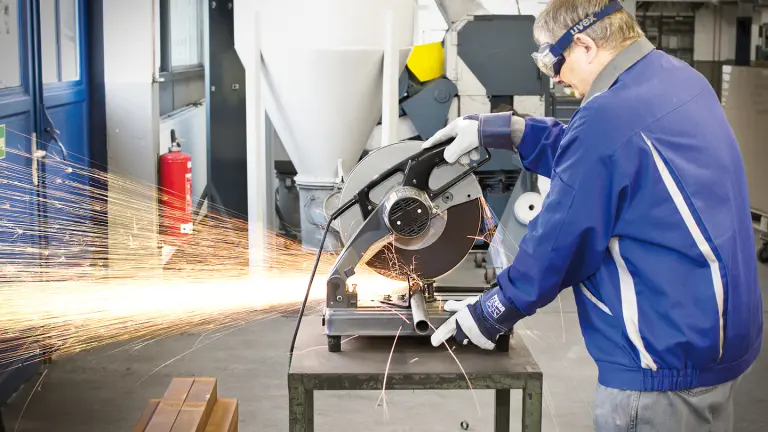
Cold cutting (up to 100°C) denotes processes where no or only minimal heat build-up should develop on the workpiece. This is particularly important if there is a need to prevent thermal changes to the material, such as tempering or distortion.
Typical cold cutting processes include circular sawing using hard-metal blades or HSS saw blades, band saws, and stationary cutting discs with and even without (dry cutting) cooling. These methods are mainly used in metal processing, such as in cutting precision parts or in aerospace engineering, where the material characteristics must be precisely preserved.
What advantages does cold cutting offer?
One major advantage of cold cutting (<100°C) is that it does not produce any structural changes or discoloration and offers high cut quality without laborious post-processing. The cuts are precise and virtually free of burrs.
However, this process is not always ideal. Cold cutting can be inefficient for very hard or thick-walled workpieces, since the cutting speed is smaller and tool wear increases.
What happens during warm cutting and where is it used?
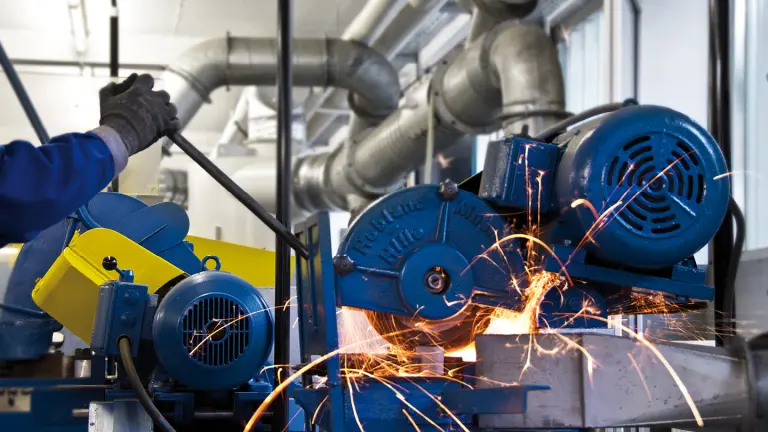
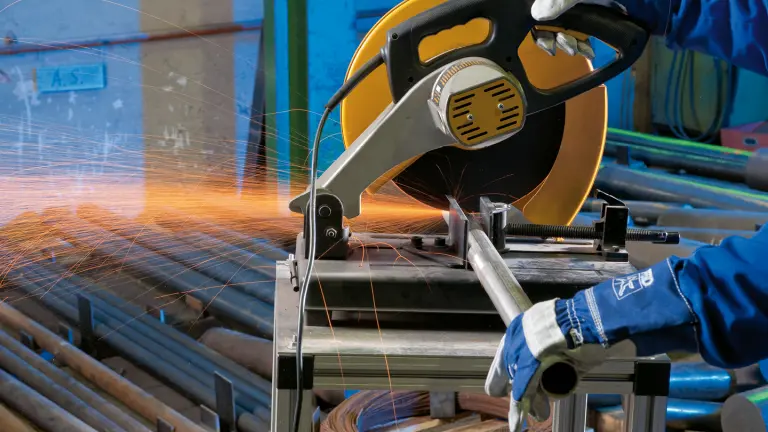
Warm cutting sits between cold and hot cutting (100-600°C). This creates a particular form of heat development that is nonetheless insufficient to significantly alter the structure of the material. Typical processes include cut-off grinding with resinoid-bonded disks, laser cutting with moderate power, and water jet cutting with abrasive additives.
These methods are frequently used in steel and aluminum processing whenever a high cutting speed is required but with a need to limit material changes.
What are the advantages of warm cutting?
One advantage of warm cutting is that it allows for significantly faster cuts than cold cutting and requires less post-processing than hot cutting. Furthermore, it is suitable for medium to large material thicknesses.
However, based on the process, it can result in warm areas that affect the material. In many cases, cooling or post-processing is required to achieve an optimum result.
Why is hot cutting so powerful and what should you be aware of?
Hot cutting (600 to over 1,000°C) produces very hot temperatures that can change the material's structure. These processes are particularly powerful and are preferred if large material thicknesses or workpieces that are difficult to cut require processing.
The most common methods include autogenous burn cutting with oxyacetylene flames, plasma cutting with ionized gas, and laser cutting at high energy levels. In mechanical engineering, heavy industry, and steel construction, these processes are indispensable if there is a need to quickly cut thick sheets or complex contours.
What characterizes hot cutting?
Hot cutting’s greatest advantage is in its extremely high cutting speed, which enables efficient processing of even massive workpieces. Furthermore, it is ideal for thick and high-strength materials and can be effortlessly automated in series production.
However, there are also disadvantages: Heavy heat-affected zones can change the material’s structure, which can change the hardness and structure of the cut edges. Post-processing such as grinding or deburring are often required, and the energy consumption of these processes is significantly higher than with cold or warm cutting.
Which cutting process is the right one for your application?
Choosing the right cutting process depends on several factors: The material, required cut quality, production speed, and post-processing.
- If precise, burr-free cuts without structural changes are important, then cold cutting is the best choice.
- If the goal is to achieve a good balance between speed and quality, then warm cutting is an option.
- For maximum performance with large material thicknesses, hot cutting is the most efficient solution.
Each process has its justification – the right choice determines efficiency and product quality. If you wish to use the best cutting process in your production:
Please contact us. Our experienced technical customer support adviser will be happy to assist you further.
Contact us now